Saturday, June 15, 2013

How to Prepare for Fire Season

2444062.jpg
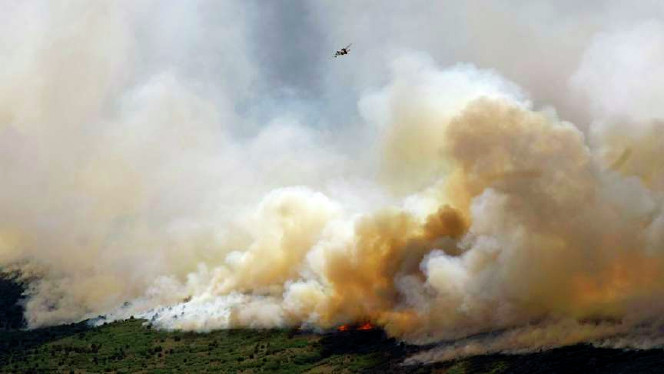
Two Thursday night fires in Utah County served as a reminder that fire season is upon the state. Wildfires may not be entirely preventable, but steps can be taken to help prevent fires and to prepare your home and family in case of evacuation...


How can you protect your home?

Creating defensible space around your home can help to save it if a wildfire gets too close. It also provides firefighters with a place from which to fight wildfires.

Doing the following will help create defensible space:

  • Remove all flammable vegetation around all structures. Contact your local fire department to find out if there is a minimal amount of clearance required.
  • Trim trees so branches are six feet from the ground and 10 feet from your chimney. Remove branches overhanging your roof.
  • Call your utility company for help with trees near power lines. Never trim them yourself.
  • Remove any dead trees. Cut weeds and dead grasses six inches or shorter.
  • Always work early in the morning and make sure your power tools have spark arresters to prevent equipment-caused fires.
  • Consider landscaping with fire-resistant plants.
  • Clean up plant litter and water properly


Read the full article by Stephanie Grimes on KSL.com by following the link below:


And another good article:
  

Thursday, June 13, 2013

"Survival Rules of Three" and "Six Guidelines for Survival"

Josh BernsteinA member of our emergency communications group,
Rich Finlinson - KG7DEN attended a gathering at the Utah Digital Government Summit, where survival expert, Josh Bernstein gave a presentation.  Here are a couple of Rich's notes.


Survival Rules of Three:

You can survive roughly…

  • 30 seconds without taking a breath*
  • 3 minutes without a heartbeat
  • 3 hours in very hot or cold conditions
  • 3 days without water
  • 3 weeks without food
  • 3 months without companionship

*Now my 2 cents: You can also breathe underwater all you want, as long as you only exhale. If you know you can resurface, you'll be much more comfortable slowly exhaling rather than trying to hold your breath.

Six Guidelines for Survival:

  • Establish and respect priorities.
  • Eliminate unhelpful concerns.
  • Focus on your needs.
  • Do more with less.
  • If need be, do less with less.
  • Never give up.

More about Josh Bernstein here:
http://en.wikipedia.org/wiki/Josh_Bernstein
http://www.boss-inc.com/staff_josh-bernstein_19.html

Josh Bernstein is an American explorer, author, survival expert, anthropologist, and TV host best known as the host of Digging for the Truth. He later appeared for one season as the host of the Discovery Channel's Into the Unknown with Josh Bernstein.

Wednesday, June 5, 2013

Include Pets in Your Preparedness Plan

For millions of animal owners, pets are important members of the household. The likelihood that you and your animals will survive an emergency such as a fire, flood, tornado or terrorist attack could depend on emergency planning done today. Knowing what supplies to have available, how to evacuate with your pets, where your pets will stay and how you will meet your pets’ needs throughout the disaster are all critical questions to address.

All pet owners are urged to keep a pet emergency supply kit, which should include at least a three-day supply of food in an airtight, waterproof container, drinking water, bowls for the food and water, current photos of you and your pets together, physical descriptions of each pet, medication, vaccination records and first aid pet supplies. Also include a leash and a pet carrier that can double as a sleeping area. You should consider comfort items for your pets as well, such as their favorite toys and blankets.

Make a back-up emergency plan in case you can’t care for your animals yourself. Develop a buddy system with neighbors, friends and relatives to make sure someone is available to care for or evacuate your pets if you are unable to do so. Talk with your pet care buddy about your evacuation plans and show them where you keep your pets’ emergency supply kit. Also designate specific locations, one in your immediate neighborhood and another farther away, where you will meet your buddy in an emergency.

Evacuating pets may be more difficult if you cannot evacuate in your own vehicle. Pet owners must understand their community’s evacuation plans and ensure they are prepared for any variations and restrictions. If officials call for an evacuation, you should be aware that many evacuation shelters do not accept pets and you must plan where you’ll shelter your pets in advance. Many hotels, motels, campsites and other facilities around the country now allow pets. For information on pet-friendly accommodations in your area, visit www.ready.gov/caring-animals.

For more information on emergency preparedness, visit Ready.gov or Listo.gov or call the toll-free numbers 1-800-BE-READY, TTY 1-800-462-7585 and     1-888-SE-LISTO. You can also text PREPARE to 43362 (4FEMA) and sign up to receive monthly disaster safety tips on your mobile phone.

Some information for this posting was used from www.FEMA.gov


Click on the link below to tee this additional story from the American Red Cross:


Sunday, June 2, 2013

Sticker helps first responders act fast, save lives

Salt Lake City — Car accident victims can now communicate more quickly with first responders, thanks to a new program in Salt Lake City.

It's called the Yellow Dot program, and it prepares drivers and their vehicles to be equipped with vital medical information in case of an emergency. It's especially useful for drivers with medical conditions; first responders can be clued into extenuating circumstances more easily.

Residents can write their medical information on a standardized form and then store it in the glove compartment of their vehicle. Then program participants will place a Yellow Dot sticker on their car in a visible area to indicate they're prepared with the forms.

"We spend a lot of time in our cars, and no matter how safe we try to be, accidents can happen," said Salt Lake County Mayor Ben McAdams. "Paramedics and firefighters are called on to administer medical attention at the scene of an accident; we can help them and ourselves by using Yellow Dot. Participating in this program is an easy way to prevent a bad situation from getting worse."

Article from KSL.com.  To read the full article, click on the link below:

Thursday, May 30, 2013

Response to Okla. tornado shows why people are awesome


Response to Okla. tornado shows why 
people are awesome.


By Susie Boyce, ksl.com Contributor

DALLAS — “Please tell me you guys are OK.”

“We’re fine. But our house is gone.”

That was the text exchange between Dale Brannon, my brother-in-law, and his friends Chuck and Marie White last Monday, May 20, after a tornado tore through the White’s neighborhood in Moore, Okla.

The Whites, along with Marie’s elderly mother, were at home when they heard on the news that a fierce tornado was heading in their direction. They were advised to drive away or get below ground. If they stayed above ground, they were told, they wouldn't survive.

So the Whites grabbed their cellphones, jumped into their car and proceeded to drive out, around and behind the tornado. After it had passed, they returned to a house and neighborhood that had been reduced to rubble; they couldn’t tell where one house ended and another began.

Follow the link below to KSL.com and continue to read how people have begun to recover from the devastation of this disaster:

                                          Response to Okla. tornado shows 
                                                why people are awesome.


Saturday, May 25, 2013

Tech Ready for an Emergency


GET TECH READY

According to The American Red Cross, the internet - including online news sites and social media platforms - is the third most popular way for Americans to gather emergency information and let their loved ones know they are safe.

Through the use of everyday technology, individuals, families, responders and organizations can successfully prepare for, adapt to and recover from disruptions brought on by emergencies and/or disasters. With effective planning, it is possible to take advantage of technology before, during and after a crisis to communicate with loved ones and manage your financial affairs.


FEMA TEXT MESSAGES

Use your cell phone’s text messaging capability to receive text message updates from FEMA (standard message and data rates apply).

Here are basic commands to get started:


  • To signup to receive monthly preparedness tips: text PREPARE to 43362 (4FEMA)
  • To unsubscribe (at any time): text STOP to 43362 (4FEMA)


PREPARE YOUR DATA AND DEVICES -- Follow this link for ideas from the American Red Cross on how to prepare yourself digitally for a disaster.

Tuesday, May 7, 2013

Ready Your Business

Click on the links below to view BeReadyUtah.org for good information on their 12 point program to business continuity planning.